
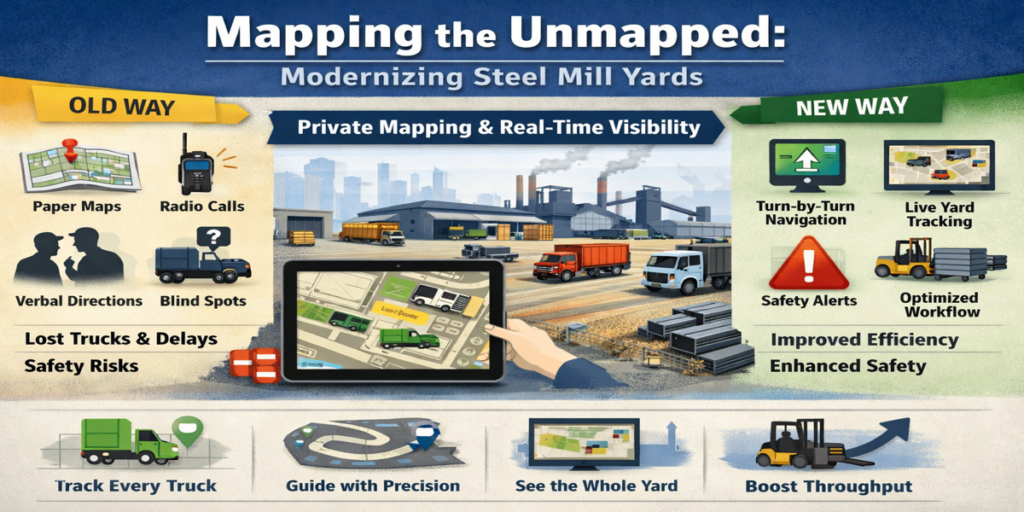
Steel mills have spent decades modernizing production lines, automation, and safety systems.
Yet inside the gate, many yards still operate on verbal directions, paper maps, radio calls, and limited visibility.
This creates a critical operational blind spot.
Once a truck checks in, teams often lose real-time awareness of where it is, where it is headed, and what is arriving next. The result is avoidable safety risk, longer dwell times, loader inefficiencies, and a frustrating driver experience that directly impacts carrier loyalty.
In complex industrial environments, modern yard operations require more than basic tracking. They require private mapping, digital routing, and shared real-time visibility across the entire facility.
Glympse CEO and president Chris Ruff explains why public maps fail in private industrial environments and how private mapping and real time visibility help steel mills run safer, faster, and more predictably. Watch the full interview here.
The Reality: Industrial Yards Are Often Unmapped Environments
“Public mapping platforms are designed for public roads. They rely on mapping vehicles, open-access data, and government sources. Private industrial facilities, including steel mills, ports, refineries, and mining sites, are closed environments,” said Ruff. That means:
- Internal roads are not mapped
- Pickup lots and staging zones are not routable
- One-way paths and restricted zones are invisible to public navigation systems
“Despite covering massive acreage and supporting constant vehicle movement, many steel yards remain digitally unmapped. This forces drivers to rely on paper maps, radio instructions, or gate directions, all of which introduce risk and inconsistency,” added Ruff.
What Happens When Routing Is Manual
When a driver is told to “go to Lot B” in a large, unstructured yard, the margin for error increases immediately. Missed turns or unclear signage can result in:
- Dead-end navigation where backing out is unsafe
- Wrong-way movement on internal one-way paths
- Entry into restricted or incorrect loading zones
- Increased radio calls and staff intervention
“Each mistake pulls loaders, yard coordinators, and scale teams away from core operations. Even small navigation issues create ripple effects across throughput, scheduling, and safety,” said Ruff.
How Glympse Help Modernize Yard Operations
Glympse enables steel mills and heavy industrial facilities to map their private property and create routable internal road networks that do not exist on public maps. This digital foundation allows facilities to guide drivers with precision from gate entry to final exit, without relying on verbal directions or printed materials. Private mapping includes:
- Internal roads and lanes
- Staging and pickup lots
- Scale houses and tarping areas
- Restricted and safety zones
- Gate-to-load routing workflows
Web-Based Turn-by-Turn Navigation (No App Required)
“One of the biggest operational barriers in heavy industry is driver adoption. Glympse removes friction by delivering navigation through a secure, browser-based link. We have added voice capabilities to this in 2026, which is truly exciting. This is especially valuable in steel environments where visiting drivers may be first-time visitors or third-party carriers unfamiliar with the site,” Ruff explained.
Drivers receive:
- Step-by-step turn-by-turn yard routing
- Voice guidance inside complex facilities
- Multi-stop workflows (scale → lot → tarping → exit)
- No app download required
Real-Time On-Site Visibility: The Unified Yard Map
Navigation solves one part of the problem. Visibility solves the rest. “Many mills have a visibility gap after gate check-in. Trucks enter the property and effectively disappear until they reach the loader or scale. This creates a single, unified yard view for gate teams, dispatch, loaders, and operations, eliminating blind handoffs across the workflow. With Glympse’s live operational map, yard teams can see:
- Who is currently on-site
- Where each truck or visitor is located
- Where they are headed
- What is queued up next by zone or lot
Loader Coordination and Throughput Optimization
Steel facilities typically have fewer loaders than active pickup lots. Without arrival awareness, equipment often moves reactively instead of strategically. Over time, this transforms the yard from reactive to predictive, improving throughput without adding infrastructure. Real-time arrival visibility allows teams to:
- Anticipate inbound trucks before they arrive at the lot
- Reduce unnecessary loader movement
- Prioritize queue order more efficiently
- Minimize idle time and congestion
Multilingual Routing Improves Safety and Clarity
“Industrial yards are high-risk environments where misunderstood directions can lead to unsafe movements. A key operational reality is that many drivers are not native English speakers. Glympse supports multilingual navigation delivered in the driver’s preferred language via their browser settings, helping reduce wrong turns in restricted zones, miscommunication at the gate and safety incidents caused by unclear instructions. Clear, digital instructions improve both compliance and driver confidence on-site,” explained Ruff.
Exception Alerts and Zone Awareness
Beyond routing and visibility, Glympse enables proactive yard management through intelligent alerts. This allows teams to intervene early instead of reacting after issues escalate. Facilities can be notified when:
- A truck enters the wrong zone
- An unscheduled or unauthorized vehicle arrives
- A driver deviates from the approved route
- Excessive dwell time occurs in a specific area
Dashboards, Reporting, and Yard Intelligence
Glympse extends beyond live maps into operational analytics that support continuous improvement. Digitizing yard movement creates actionable data that can feed back into scheduling, staffing, and upstream logistics decisions. Capabilities include:
- Live dashboards of on-site activity
- Dwell time tracking by zone or workflow stage
- Arrival and queue insights
- Time-on-site reporting
- Yard performance metrics for planning and optimization
Improving the Driver Experience = Becoming a Shipper of Choice
In heavy industry, driver experience is a competitive differentiator. Drivers often only earn when they are driving. Time spent waiting, getting lost, or navigating unclear yards reduces income and discourages return visits. By providing the very things Glympse offers significantly improves carrier relationships and helps position companies as a shipper of choice in a tightening driver market.
A Repeatable Framework Across Heavy Industry
While steel mills are a leading use case, the same challenges exist across any large, private and unmapped facility benefits from onsite, voice navigation and real-time visibility, including:
- Ports and terminals
- Rail yards
- Refineries and chemical plants
- Mining operations
- Utilities and construction mega-sites
- Data center build-outs
Private Mapping as a Foundation for the Future
“As autonomy and advanced logistics technologies evolve, private maps will become even more critical. Autonomous and semi-autonomous vehicles may navigate public roads using traditional mapping systems, but once inside private facilities, they require defined internal routing infrastructure. Building private digital maps today prepares industrial operators for the next decade of transportation and automation,” said Ruff.
The Takeaway: From Blind Yards to Coordinated Operations
Steel mills do not need more complexity. They need clarity. By combining private mapping, web-based driver routing, real-time yard visibility, multilingual guidance, alerts, and operational dashboards, Glympse helps heavy industrial facilities:
- Reduce safety risk
- Cut dwell time
- Improve loader coordination
- Increase throughput
- Eliminate on-site blind spots
- Strengthen carrier relationships
If your facility still relies on verbal directions, radio calls, and paper maps inside the gate, the opportunity is clear: map the unmapped, digitize the workflow, and transform the yard into a coordinated, predictable operation.
Want to Learn More?
If you are evaluating private yard mapping, real-time visibility, or driver routing for a steel mill or heavy industrial site, Glympse can provide a tailored walkthrough of how unified yard maps, gate-to-load routing, and live operational dashboards work in complex facilities.