
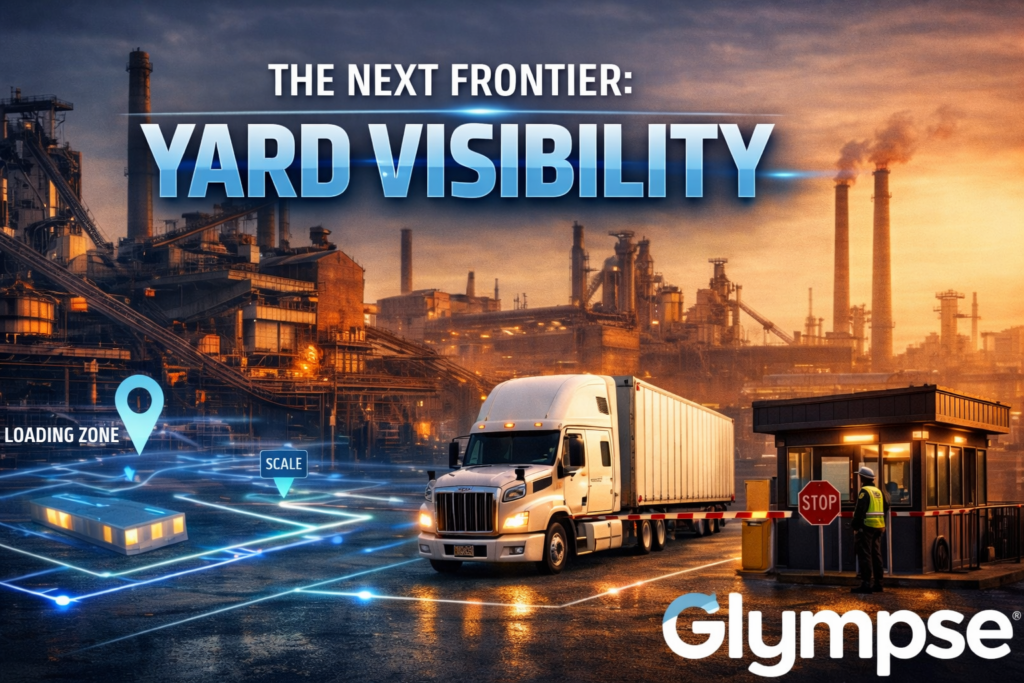
Steel is one of the most advanced, automated industries in the world yet one of the most basic operational realities still hasn’t changed:
Drivers still get lost onsite.
It sounds almost too simple to be true. But many of the largest steel and heavy industrial facilities still operate inside a massive blind spot; one that modern logistics and visibility tools weren’t built to solve. That blind spot is not a sensor problem. It’s not a fleet problem. It’s not even a gate problem. It’s a mapping problem.
Because the hard truth is: most heavy industrial properties are not fully represented on public mapping platforms like Google Maps. And without accurate yard-level mapping, the entire onsite workflow becomes vulnerable routing breaks down, dwell time grows, safety risk rises, and valuable labor gets converted into something it was never meant to be: human routing.
In 2026, that’s no longer sustainable.
Steel Has a “Yard Visibility Gap” That Most Tech Still Can’t See
In supply chain conversations, visibility usually means:
- Where is my shipment?
- What’s the ETA?
- Has it arrived?
But for steel, aluminum, mining, ports, data center facilities, timber, and other heavy industrial industries, the true breakdown happens after arrival, at the moment a driver hits the gate entrance.This is where most traditional tracking stops, and where operational chaos quietly begins:
- Drivers are unsure where to go
- Wrong turns lead to safety issues
- Gate staff and loaders time redirecting trucks
- Safety teams deal with near misses that never needed to happen
- A visitor gets into the wrong zone and now it’s a compliance and safety issue
It becomes a loop:
Confusion → delay → calls → human routing → more delay → more risk.
And the bigger the yard, the bigger the problem.
The Root Cause: Most Industrial Yards Don’t Exist Digitally
Here’s what many people outside industrial operations don’t realize: A steel mill is not “one address.” It’s a living environment…and each facility is unique. Most private yards aren’t mapped like cities are. Public mapping platforms were designed for public roads and destinations, not:
- Private haul roads
- Internal yard traffic patterns
- Restricted zones
- Industrial signage and routing logic
- Gate permissions
- Safety corridors
- Multi-lingual driver needs
So even if the general facility address exists on a map, the operational truth is still the same: the yard itself is effectively invisible. And when a site is invisible, it can’t be optimized.
What That Visibility Gap Costs Steel Operations Every Day
When mapping doesn’t exist, steel mills pay for it repeatedly in time, labor, throughput, and safety.
1) Dwell time explodes
Every wrong turn becomes:
- 10 minutes
- 20 minutes
- an hour
…and multiplied across dozens or hundreds of daily truck visits.
Even “minor” confusion at scale becomes a measurable throughput issue.
2) Gate check-in becomes a bottleneck
If the gate is the only place a driver can get direction, the gate becomes the choke point. And this impacts:
- Appointment flow
- Staffing needs
- Backup and overflow risk
- Visitor control
3) Frontline teams become human routers
Gate and loader teams spend a painful portion of their shift giving directions, repeating instructions, and resolving location confusion.
That’s labor waste and it’s incredibly expensive in high-traffic environments.
4) Safety risk rises
Steel sites have forklifts, cranes, heavy equipment, restricted zones, rail crossings and limited margin for error. If drivers don’t know where they’re going, safety becomes reactive. And today, safety can’t afford to be reactive.
What “True Yard Visibility” Actually Looks Like Today
Steel leaders aren’t asking for fancy dashboards. They want a yard that runs smoothly, safely, and predictably, with fewer radio calls, fewer backups, fewer mistakes, and fewer preventable risks. True yard-level visibility includes:
- Private mapping of internal roads, zones, checkpoints, and destinations
- Digital routing inside the property (not just to the property)
- Turn-by-turn directions for drivers onsite
- Gate check-in modernization
- Geofence-enabled alerts and automation
- Dwell time, wait time, and exception insights
- Multi-party coordination across carriers, gate teams, safety teams, and loaders
In other words: a site that operates like a modern logistics network, not like a maze.
The Missing Layer: Private Yard Mapping (Built for Heavy Industry)
This is exactly where Glympse is focused. We’re working with leading steel and heavy industrial groups to build private mapping for industrial properties and then adding the Magic of Glympse to the foundation required to unlock modern onsite operations. Once a yard is mapped correctly, mills can instantly enable solutions that previously were not possible through public maps or traditional logistics systems. This is how mapping becomes a strategic platform, not a one-time project.
What Steel Mills Can Unlock After Mapping Is in Place
Once accurate private mapping exists, multiple solutions become available immediately, including:
1) Onsite, web-based routing (in the driver’s language)
Not every driver reads English fluently, and not every steel site has clear signage. Glympse enables web-based, turn-by-turn directions onsite so drivers can:
- Get to the correct location the first time
- Avoid restricted zones
- Follow the approved traffic flow – and do it safely and efficiently.
2) Modernized gate check-in workflows
With mapped zones and digital flows, mills can modernize entry by enabling:
- Arrival verification
- Appointment-based routing
- “right driver / right load / right destination” logic
- Alerts if a driver shouldn’t be onsite
- Reducing lines and confusion at entry
3) Reduced dwell time + increased throughput
Private mapping enables visibility across the yard, not just the gate. That supports:
- Better staging coordination
- Fewer wrong turns
- Fewer radio/CB calls
- Faster cycle time from entry to exit
4) Safety + compliance improvement
Safety teams can establish:
- Approved routes and safe corridors
- Restricted zone boundaries
- A solution to keep drivers who aren’t supposed to onsite OFF site
Why This Matters Now: Steel Can’t Compete With Blind Spots
Today, steel leaders are under pressure from every angle:
- Labor shortages
- Rising operational costs
- Increasing customer expectations
- Tighter safety standards
- A need to move faster with fewer errors
The next competitive frontier won’t just be AI or automation. It will be operational clarity. And that clarity begins with something surprisingly foundational: mapping the yard. Because if you can’t see the yard digitally, you can’t optimize it. And if you can’t optimize it, you can’t scale it.
The Bottom Line
Steel mills have modernized production dramatically, but the operational flow of trucks, drivers, visitors, and contractors often still relies on outdated assumptions:
- People will find their way
- Gate staff will direct them
- Radio calls will fill the gaps
That’s no longer enough. The next major shift in steel operations is happening now: from public maps to private industrial mapping and from manual coordination to automated yard intelligence.
And Glympse is helping steel leaders build the foundation to do it safely, efficiently, and at scale.
Want to see what this looks like for a steel mill?
If your team is dealing with:
- Gate backups
- Onsite routing confusion
- Rising dwell time
- Safety risk from misrouted drivers
- Blind spots at handoffs
- Language barriers
Glympse can help map your site and unlock solutions immediately. Let’s talk.