
For those of us who have spent years in the connected vehicle and autonomous vehicle industries, the conversation around autonomy has changed dramatically. For a long time, the question was: Can we make the vehicle smart enough? Can it understand its surroundings? Can it navigate safely? Can it make decisions in real time? Can vehicles communicate with infrastructure, systems and each other?
Increasingly, the answer is yes.
The more interesting question in today, though, is: What happens when a very smart vehicle arrives at a facility that isn’t equally connected?
That question has become particularly relevant in recent weeks.
In September, Einride and Lidl announced that a cab-less SAE Level 4 autonomous truck had entered regular operations on a public road in Germany under authorization from Germany’s Federal Motor Transport Authority. It is transporting goods between a Lidl distribution center and a retail store. That is not a concept vehicle driving around a test track. It is freight moving as part of an actual commercial operation.
Meanwhile, autonomous vehicle deployments are expanding inside logistics facilities as well. CEVA Logistics announced this month that it is piloting autonomous electric vehicles at its Blue Hub in Singapore, moving pallets and inventory between floors of the facility. And here in the United States, autonomous trucking deployments continue to move into new operating environments.
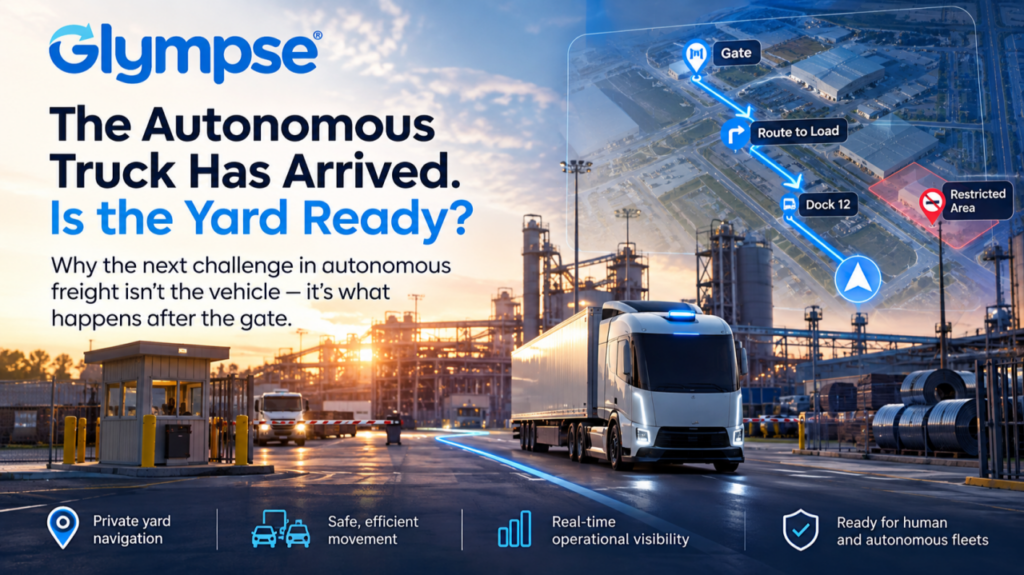
The technology is advancing. But something Chris Ruff, CEO of Glympse, and I have discussed for years is becoming increasingly important. Autonomy doesn’t end when the vehicle leaves the public road. In many industrial operations, that’s where the complicated part begins.
“The highway may actually be the easy part.”
Chris and I both come to this discussion with backgrounds that reach well beyond traditional logistics technology. We’ve spent significant portions of our careers around connected vehicles, mobility and the evolution of location technology. I asked him what he believes the industry is overlooking as autonomous freight becomes operational.
His answer was simple: “We have spent years solving how a vehicle gets from Point A to Point B. But for industrial freight, Point B often isn’t the destination. It’s the front gate.”
Consider what happens next. A truck arrives at a steel mill, manufacturing campus, port, mine, distribution center or other large private facility. The facility may encompass hundreds or even thousands of acres. There may be multiple gates. Private roads. One-way roads. Temporary closures. Restricted areas. Staging locations. Loading areas. Different routes depending upon what the truck is carrying, where it needs to load or unload, and what is happening operationally that day.
Those roads frequently don’t exist accurately, if at all, on conventional public mapping platforms. And an autonomous vehicle does not eliminate those complexities. In some ways, it makes solving them more important.
The industry is beginning to see the same problem
FreightWaves recently examined what is slowing broader adoption of autonomous yard trucks. The conclusion is important. The challenge is increasingly not simply autonomous vehicle technology. It is the operating environment around it.
Douglas Taylor of Autonomous Solutions told FreightWaves that autonomous yard technology has reached commercial viability, while facilities still face inconsistent processes, varying yard-management-system adoption and physical infrastructure that was originally designed around human-operated vehicles. His assessment was succinct: “It’s not really a technology problem at this point.” That distinction matters.
Another recent FreightWaves examination of autonomous trucking described private yards as one of autonomy’s most promising frontiers. The reasoning makes sense: lower speeds, controlled environments and private property can remove some of the complexities encountered on public roads. But controlled does not necessarily mean simple. A yard still has to tell the vehicle, and everyone operating around it, where to go.
Chris put it this way when we discussed it: “An autonomous vehicle still needs operational context. Knowing your latitude and longitude isn’t the same thing as knowing where you are supposed to go, which route you’re permitted to take, what areas you’re prohibited from entering and what is happening around you.” That distinction, between location and operational context, is going to become increasingly important.
GPS knows where you are. Operations need to know where you’re going.
We’ve become extraordinarily good at determining location. As I have mentioned before, the little blue dot has won. But industrial operations require something considerably more sophisticated than a dot on a map. A facility needs to understand: Where is the vehicle? Why is it here? Where is it supposed to go? Which route should it take? Is that route appropriate for this vehicle or load? Has it entered an unauthorized area? How long has it been in a particular zone? Is a loading area ready for it? What other vehicles, equipment or people are moving through the same environment? And what happens when the plan changes?
That last question may ultimately be one of the most important. Autonomy depends upon data. Industrial operations constantly create new data. The two have to meet.
We are already encountering this problem today
This is where the conversation became particularly interesting for Chris and me. At Glympse, we aren’t waiting for a fully autonomous freight ecosystem to encounter these challenges. We are solving many of them today with human drivers. Large industrial facilities are already dealing with the fundamental problem autonomous freight will eventually have to solve at scale: how do you intelligently orchestrate movement through a complex private environment?
Glympse digitizes private industrial roads, gates, staging areas, restricted zones and loading locations. Drivers can receive facility-specific, voice-guided turn-by-turn directions without downloading an application.
Operations teams can simultaneously see who is onsite, where vehicles are headed, how long they have been on property and whether they are approaching or entering areas where they should not be. Geofencing creates another layer of operational intelligence around that movement.
Today, the directions may be delivered to a driver’s smartphone. Tomorrow, increasingly, that information may need to be consumed by an autonomous system. The underlying problem is remarkably similar.
Chris described it this way: “Whether the driver is a person or eventually an autonomous driving system, the facility still has to provide a source of truth. The vehicle needs to understand the private environment, and the operation needs visibility into the vehicle. That connection is where this gets really interesting.”
Human and autonomous vehicles will coexist
There is another reality that deserves considerably more attention. The transition to autonomy will not happen overnight. For years, facilities are likely to operate mixed environments containing company vehicles, third-party carriers, contractors, employees, visitors, autonomous vehicles and human-driven trucks simultaneously. That may actually make operational visibility more important during the transition than after it.
A facility cannot reasonably maintain one operational picture for autonomous vehicles, another for company fleets and another for the thousands of third-party drivers who may arrive without ever having visited the property before. There needs to be a shared operational layer. One map. One understanding of the facility. One view of what’s moving through it.
And the ability to communicate the correct route and operational instructions regardless of who, or eventually what, is driving.
The next AV challenge may not be the vehicle
The autonomous vehicle industry has accomplished extraordinary things. Vehicles can perceive their environment, interpret enormous amounts of information and make driving decisions in milliseconds. But freight doesn’t exist simply to move vehicles. Freight exists to move something somewhere for a reason. Lke a coil of steel needs to reach a particular loading location. A container needs to reach the correct terminal position. A pallet needs to arrive at the correct dock. A contractor needs to reach a particular area of a facility without accidentally entering another.
Knowing where something is matters. Knowing where it belongs next matters more.
That is why I believe the next chapter of autonomous logistics will increasingly move beyond autonomous driving and toward autonomous operations. And that requires connecting the intelligence inside the vehicle with the intelligence inside the facility.
We want to be part of that conversation
Glympse has spent years solving location problems, first across connected mobility and now increasingly inside some of the most complicated industrial environments. That gives us an unusual perspective on what comes next. We don’t claim that one company will solve autonomous logistics. It will take AV developers, OEMs, mapping companies, infrastructure providers, logistics platforms, industrial operators and technology companies working together.
But there is a particular problem we understand extremely well: What happens between arriving at the gate and arriving where you actually need to be?
We are already solving that problem.
And as autonomous freight moves from demonstration to everyday operation, we believe that experience can help companies think through not only the technology they will need, but how their facilities, processes, private maps, operational data and existing systems need to evolve around it.
For companies beginning to think about autonomous vehicles inside private facilities, we are happy to start that conversation well before there is a Glympse project attached to it.
Sometimes the first step isn’t buying technology. It’s mapping the problem.
And after decades of working around connected vehicles, location and mobility, Chris and I would argue that the most interesting part of the autonomous freight journey may be starting exactly where the public map ends……..at the gate.