
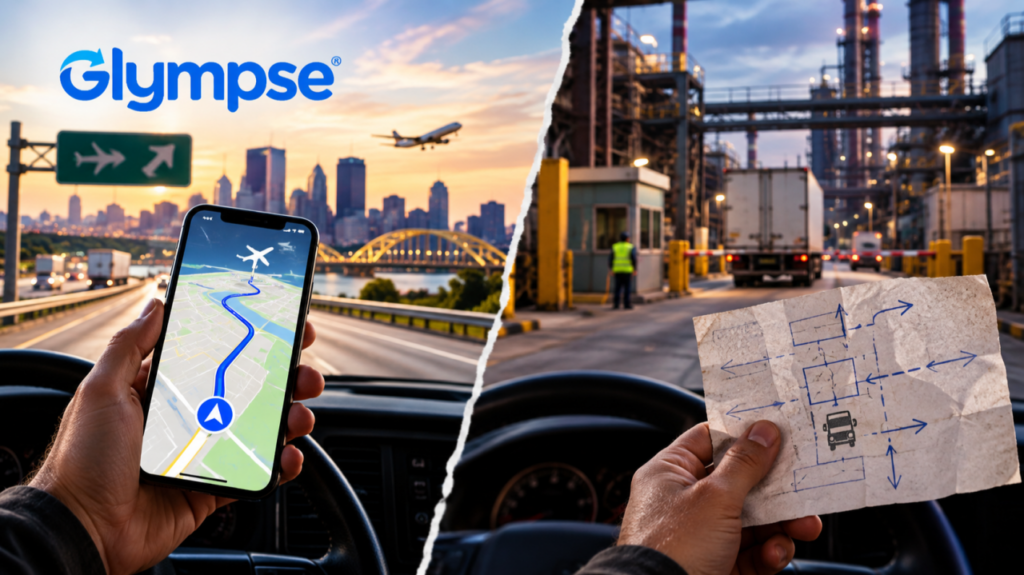
Take out your phone. Type “Nearest Airport” into whatever mapping app you use. Within seconds, you know exactly how to get there. You have turn-by-turn directions, real-time routing, estimated arrival time, traffic updates and automatic rerouting if something changes. And you can get those instructions in the language you understand best.
Now imagine I take your phone away.
You still need to get to the airport, but instead of navigation, someone hands you written directions. And those directions are in Ukrainian. How confident are you that you’ll get there efficiently? More importantly, how safely will you get there?
Now Put That Driver Inside a Heavy Industrial Facility
This is where industrial operations have an interesting blind spot. A truck driver can travel hundreds or thousands of miles using sophisticated navigation technology to arrive at a steel mill, manufacturing plant, distribution center or other industrial facility.
Then the driver crosses the gate. And suddenly, the technology often disappears. Now the driver needs to find a scale, loading area, dock, staging location or exit using signs, printed maps or verbal instructions. Meanwhile, they’re navigating around heavy equipment, rail crossings, restricted areas, pedestrians and other trucks. And they may be doing it inside a facility they’ve never visited before or in a language that isn’t their first.
Why does navigation stop precisely where the environment becomes more complex and potentially more dangerous?
Inside the Gate, the Responsibility Changes
Outside the gate, getting to the facility is largely the driver’s responsibility. Inside the gate, safe and efficient movement becomes the facility’s responsibility. That’s why this isn’t simply a navigation problem.
It’s a safety problem.
It’s an operational problem.
And it’s a financial problem.
Every wrong turn creates unnecessary movement. Every driver searching for a destination adds time. Every truck sitting in the wrong place contributes to dwell and potentially congestion. Multiply those minutes across hundreds of trucks per day and thousands of visits per year, and what appears to be a small inconvenience can become a significant operational cost.
What If the Yard Worked More Like the World Outside It?
Imagine a driver approaching a facility and receiving a simple link; no new app required. They check in. Their destination is assigned. And turn-by-turn navigation guides them through the private facility to exactly where they need to go, using the roads they’re permitted to travel and instructions they can understand. If something changes, the route changes. At the same time, operations has a shared, real-time view of movement across the facility.
Now the question isn’t simply: “Where’s that truck?” It becomes: Where are trucks accumulating? Where is dwell increasing? Where are drivers getting lost? Which areas are creating bottlenecks? How long does gate-to-load actually take? Where are we creating unnecessary movement?
That’s when navigation becomes something much bigger. Navigation solves the driver’s problem. Visibility starts solving the facility’s problem.
From Location Tracking to Location Intelligence
For years, industrial organizations have invested heavily in understanding the movement of products and materials.Where is the inventory? Where is the shipment? Those are important questions.
But there’s another one: What about the people and vehicles moving those products? Real-time location intelligence gives operations teams the ability not only to see movement, but to understand it. Where is something? Where should it be? How long has it been there? What’s happening around it? What should happen next? That’s the difference between putting another dot on a map and creating actionable operational intelligence.
The Opportunity Inside the Gate
Sometimes increasing capacity doesn’t require another gate, another lane or another employee. Sometimes it comes from making the infrastructure you already have work better. Reduce unnecessary movement. Reduce dwell. Improve traffic flow. Help drivers reach the correct destination the first time. Give operations visibility into what’s actually happening. And, most importantly, help people navigate complex industrial environments more safely.
We already expect this level of intelligence everywhere else in our lives. Maybe it’s time to expect it inside our industrial facilities, too.
Because the next major opportunity in industrial operations may not be getting more trucks into the yard. It may be getting every truck through the yard better.