
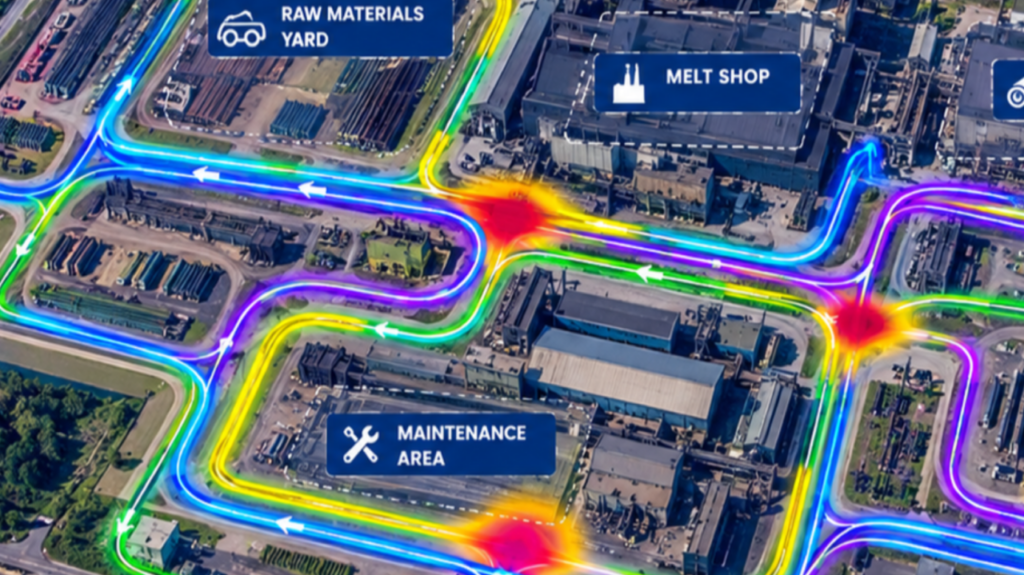
Why private digital mapping and operational data may become essential building blocks for AI, automation, and autonomous industrial operations.
Autonomous trucks. Self-driving industrial vehicles. Robotic equipment. AI-powered operations. The future of industrial transportation is rapidly evolving. Across manufacturing, logistics, and heavy industry, companies are exploring technologies designed to reduce costs, improve safety, and increase operational efficiency.
But amid all the excitement surrounding autonomous vehicles, there’s a question that deserves more attention. How does an autonomous truck know where to go once it enters an industrial facility? It’s a deceptively simple question. And answering it reveals a much bigger challenge facing the next generation of industrial operations.
Public Roads Are Not Private Industrial Facilities
Today’s navigation technologies are remarkably sophisticated. Drivers can travel thousands of miles using digital maps that provide turn-by-turn directions, traffic updates, and alternate routes. Autonomous vehicles take this much further, combining mapping information with sensors, positioning technology, perception systems, and sophisticated decision-making capabilities. But industrial environments present a different challenge.
Consider a large steel mill or shipping yard. Its internal road network may include roads that don’t appear on public maps. Certain routes may be restricted to specific vehicle types. Loading locations may change. Rail crossings, pedestrian zones, heavy equipment, and temporary construction areas create additional complexity. And unlike public road networks, industrial environments may change frequently based on operational requirements. Getting an autonomous truck to the facility is one challenge. Helping it operate within that facility is another.
Who Owns the Digital Map of Your Facility?
There’s another consideration that industrial leaders shouldn’t overlook. Control.
Your facility’s internal roads, restricted zones, operational destinations, and infrastructure represent valuable information.That information may be sensitive. And it may not belong on a publicly accessible mapping platform. Industrial organizations need the ability to determine which routes are approved, which destinations are accessible, and who is authorized to receive that information.
This is where private digital mapping becomes increasingly important. Rather than relying exclusively on public navigation systems, facilities can create controlled digital representations of their internal environments. These maps can include approved road networks, operational destinations, restricted areas, and other information necessary to support vehicle movement.
Your facility. Your infrastructure. Your data. Your control.
But private mapping isn’t only about controlling access. t’s about creating a foundation for more intelligent operations.
Before AI Can Improve Operations, It Needs to Understand Them
Artificial intelligence is becoming part of nearly every industrial technology conversation. Predictive maintenance. Production optimization. Automated scheduling. Intelligent resource allocation. But there’s a fundamental requirement underlying these capabilities.
AI needs reliable data.
Consider what many industrial facilities know about the vehicles entering their property. They may know when a truck arrives. They may know when it leaves. But what happens in between? Where did it travel? How long did it remain at a particular location? Did it follow the expected route? Was it stationary for two hours (someone checking social media)? Did it encounter congestion? Was it waiting for loading equipment?
Without reliable operational data, answering these questions can be difficult. Location information can reveal routes, movements, and time spent in specific areas. Combined with information from transportation, yard management, and other operational systems, it can help organizations better understand why delays occur. That distinction matters. Knowing a truck remained stationary for 90 minutes is useful. Knowing that it remained stationary because a loading crane was unavailable is far more actionable.
The real opportunity comes when physical movement data becomes connected to operational context.
From Location Visibility to Operational Intelligence
Imagine being able to analyze the movement of hundreds of vehicles throughout an industrial facility. Not just in real time. But across days, weeks, and months. Patterns begin to emerge. Certain routes consistently experience congestion. Specific loading areas generate longer waiting times. Contractors spend more time in particular operational zones. Vehicles frequently take routes that differ from those originally planned.
With sufficient data, facilities can begin identifying opportunities to improve traffic flow, reduce delays, allocate resources more effectively, and strengthen safety procedures. This is where location technology evolves from a navigation tool into something much more valuable.
Operational intelligence.
And it’s where the conversation about AI becomes especially interesting. Because before AI can recommend how to improve a facility, it needs access to reliable information about how that facility actually operates. You can’t optimize what you don’t measure. And you can’t measure what you can’t see.
Building the Digital Foundation for Autonomous Operations
Now consider how this connects to autonomous vehicles. Today, a private digital facility map can help a human driver navigate safely and efficiently. Tomorrow, that same foundational information could support more advanced industrial automation systems.
A digital representation of internal roads, destinations, and operational zones can provide valuable environmental context. When combined with the additional positioning, perception, safety, and control systems autonomous vehicles require, this information may become part of a broader connected industrial infrastructure. Importantly, a digital map alone does not make a vehicle autonomous. Autonomous systems require sophisticated technology, rigorous safety engineering, and integration with operational environments.
But reliable information about the physical environment is an important part of the larger challenge. And facilities that begin developing that information today may be better positioned to evaluate and adopt future technologies.
The Opportunity for Industrial Leaders
For organizations considering investments in AI and automation, the question shouldn’t simply be: What new technology should we purchase?
It should also be: What information are we missing about how our operations actually work?
Because some of the most valuable opportunities may be hiding in processes that have existed for decades. Truck movements. Gate operations. Loading and unloading. Contractor activity. Internal transportation. These activities generate operational information that, when captured and connected appropriately, can help organizations make better decisions. And importantly, facilities don’t need to wait for fully autonomous operations to begin realizing value. Improved navigation, better visibility, reduced delays, and stronger operational coordination can provide benefits today.
The Future Requires More Than Smarter Machines
Industrial automation is often discussed in terms of the machines themselves. Smarter trucks, robots, equipment. But the next generation of industrial operations will require more than intelligent machines. It will require environments capable of supporting them.
Environments with reliable digital maps. Connected operational systems. Trusted movement data. And the ability to translate physical activity into meaningful information.
At Glympse, we see private industrial navigation and location visibility as potential building blocks for that future. Not because navigation alone will transform industrial automation. But because understanding where things are, where they’re going, and what’s happening along the way is fundamental to connecting physical operations with digital intelligence.
We’re spending millions preparing our machines for the future. But are we preparing our facilities for those machines?
The future of industrial automation isn’t just about smarter vehicles. It’s about smarter facilities. And that work can and should start today.